

January is closer than it feels. Holiday displays will come down, new items will go up, and store teams will want every shelf right by the first full week back.
When we started planning our fall conversations with grocery teams, we went looking for what’s changing on the shelves and on the floor. Four trends kept showing up. Together they point to one practical idea: grocery store resets in 2027 will be bigger and busier than most calendars assume, and the teams that plan early will get the dates they want.
The short version
- Store brands reached a record 23.8% of U.S. grocery unit sales in the first half of 2026, so resets carry more new items.
- Fresh and prepared foods are growing fastest, which pulls remodel scope toward the store perimeter.
- Growth is selective. Aldi is opening 180+ stores this year, so new stores, conversions and remodels cluster in the same markets.
- The calendar is the real constraint. Lock January resets in October, Q1 remodels in November and spring work in December.
What is a grocery store reset?
A grocery store reset is the planned, physical reorganization of shelves to match a new planogram. Crews clear the old set, build the new one and check it against the plan. Resets cover category updates, new items and seasonal changes. A remodel goes further and changes fixtures, layout or departments.
Both jobs depend on skilled hands in the right store at the right time. That’s why the calendar matters as much as the plan.
Why is private label making grocery resets bigger?
Because more store-brand items need a place on the shelf. Store brands reached a record 23.8% of U.S. grocery unit sales in the first half of 2026, according to the Private Label Manufacturers Association (PLMA), using Circana data. Over those six months, store-brand unit sales rose 0.2% while national-brand units fell 0.5%
The longer view tells the same story. Circana puts 2025 private label sales at $330 billion, about 24% of U.S. retail food and beverage dollar share. An FMI survey found that 49% of shoppers increased their private-label purchases over the past year, including 59% of Gen Z.
More store-brand items mean more cut-ins, new items added to an existing set. Each one needs a home on the shelf and has to land correctly in every store. Teams that map reset waves by region in October have time to sequence that work. Teams that wait can end up squeezing it into the first week of January.
How are fresh and prepared foods changing grocery remodels?
They’re pulling attention to the perimeter. Circana data presented at IDDBA 2026 showed meat sales up 6.5% and deli-prepared up 3.7% year over year.
IDDBA says the fresh perimeter is where grocery innovation shows up first, from ready-to-heat meals to grab-and-go formats and smaller portions.
That growth needs somewhere to live. Grab-and-go cases, prepared food counters and larger fresh sets all add fixture work to a remodel. At SASR we handle fixtures and merchandising together, so each store finishes in one pass and the team gets the floor back sooner. Learn more about our remodel services.
If a deli refresh or a bigger prepared foods footprint is on your 2027 list, keep an eye on Q1. Crew calendars start filling once budgets close.
Where are new grocery stores opening?
Growth is selective, and it’s happening in clusters. Aldi plans to open more than 180 stores across 31 states in 2026, taking it to nearly 2,800 locations by year-end and 3,200 by 2028. It also expects to convert nearly 80 former Winn-Dixie and Harveys stores this year, with more than 200 conversions in total by the end of 2027
Established chains are reshaping their footprints too. Albertsons completed 15 remodels and opened four new stores in the 16 weeks ended June 20, according to its quarterly filing.
That’s a lot of movement. Some stores are opening, some are converting, and many more are being refreshed. Each move ends with the same result: a store that’s set up and ready for shoppers. Spring openings need the same early planning as January resets, and our new store teams and category update crews follow the same calendar.
When should grocers plan resets, remodels, and new store setups?
About 60 to 90 days before the work starts. Crew calendars fill up earlier than most teams expect, and it’s easiest to get the dates you want while the calendar is still open.
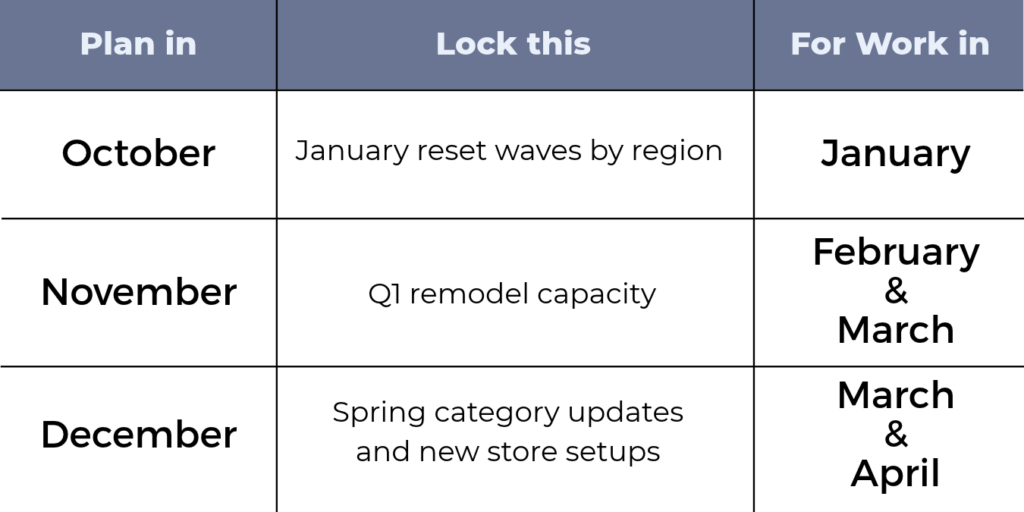
A steady rhythm like this gives your store teams a clear picture of what’s coming. They can stay focused on shoppers while the work happens.
What to do this month
You don’t need a finished plan to start. You need three lists.
- Your January category review changes, with cut-ins counted by region.
- Q1 remodels that are approved and ones still pending, with any fresh or prepared food fixtures flagged.
- Spring openings and category updates with target dates, even if the dates are still rough.
Send those lists our way and we’ll help turn them into a calendar.
SASR’s reset teams bring more than 20 years of experience, and our nationwide W-2 workforce covers all 50 states. See how we support grocery teams. If January resets, Q1 remodels or spring openings are on your calendar, let’s find a time to talk.
Grocery Reset and Remodel Planning: Common Questions
What is the difference between a grocery reset and a remodel?
A reset changes what is on the shelf and where it sits, following a new planogram. A remodel changes the store itself, such as fixtures, layout, or departments. Many projects include both, so it helps to schedule them together.
How far ahead should grocers schedule resets and remodels?
Plan about 60 to 90 days ahead. Lock January resets in October, Q1 remodel capacity in November, and spring work in December. Early dates give crews time to prepare and give store teams time to plan around the work.
Why does private label affect shelf resets?
Store brands keep adding new items, and each new item must be cut into an existing set. More items mean more cut-ins in each category review, so resets take more planning and more precise execution.
Who handles grocery resets and remodels?
Many grocers work with a retail execution partner for resets, remodels, new store setup, and category updates. SASR Workforce Solutions supplies W-2 crews who run the work store by store while your team keeps selling.
Does SASR serve grocers nationwide?
Yes. SASR works in all 50 states with a nationwide W-2 workforce and centralized operations, so one plan can cover every market.
SASR Workforce Solutions, headquartered in Cary, NC, is a retail execution management company and national project management partner. We serve retail, grocery, convenience store, and construction customers in all 50 states. Backed by a nationwide W-2 workforce, centralized operations, and advanced technology, our teams execute fixtures, remodels, resets, and rollouts with precision and scale, from planning to completion.
Sources
SASR Workforce Solutions, headquartered in Cary, NC, is a national workforce solutions and project management partner serving retail, grocery, convenience stores, and construction industries across all 50 states. We help the nation’s leading brands execute fixtures, remodels, resets, rollouts, and special projects with precision, speed, and scale. Backed by a nationwide W-2 workforce, centralized operations, and advanced technology, SASR delivers customized workforce solutions that drive executional excellence and operational efficiency from planning to completion.